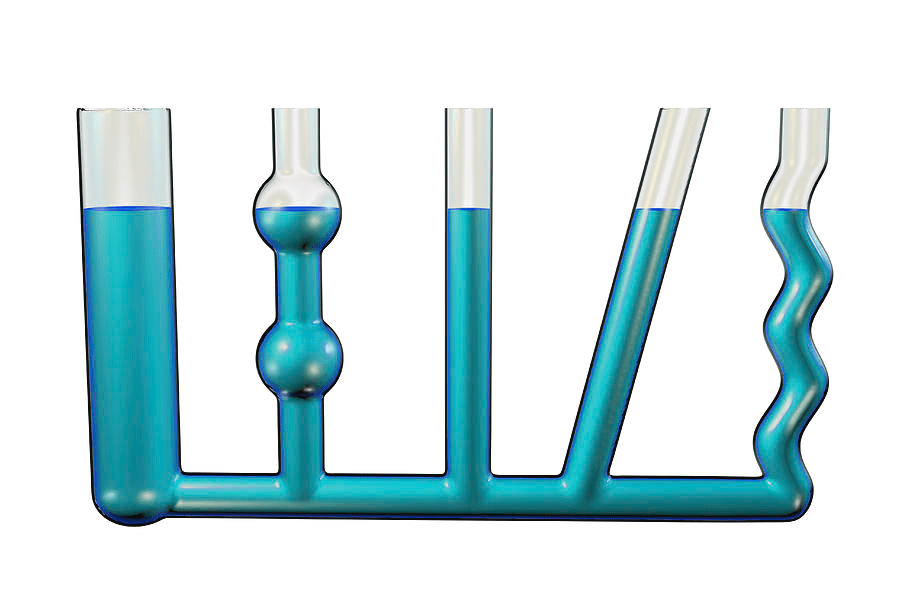
Today’s physics class was focused on liquids — but not the easy, predictable kind of problems. The ones we tackled today were hard. Not just because of the formulas, but because they required deep understanding of how liquids behave in every possible situation.
We studied communicating vessels, but instead of basic questions, our teacher gave us complex cases — vessels with different cross-sectional areas, connected by slanted tubes, and even some contain solid objects. Solving them wasn’t about memorizing formulas; it was about truly understanding pressure equilibrium and how each point in the fluid responds to gravity. Every small change in shape or liquid type could flip the entire result, so we had to think carefully and visualize the forces in detail. The problems we solve also heavily rely on geometry.
Then came Archimedes’ Principle, but again, the problems were far beyond the usual “floating or sinking” type. We worked on situations where the buoyant force changed dynamically — like objects partially submerged in two different liquids, or bodies whose volume shifted as they rose or sank. Some problems even required simultaneous equations to balance forces and find exact submerged depths. It felt more like a puzzle than a normal exercise — every step had to be perfectly reasoned.
By the end, my brain felt like it had done a marathon — but in a good way. These tough problems showed how beautiful physics can be when you fully understand the phenomena behind the formulas. It’s not just about solving; it’s about thinking like a physicist, and in our school, that’s exactly the kind of challenge I enjoy most.
 Louis La Minh Hoang
Leave a comment