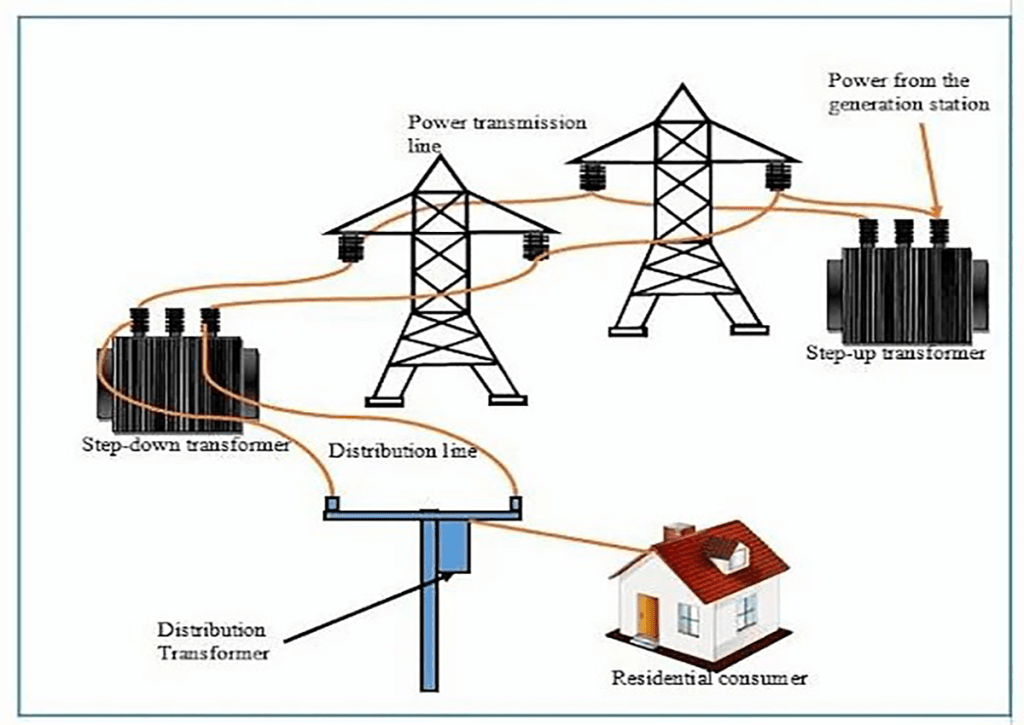
Today’s physics class took things to an entirely new level — we explored electricity transmission at a very advanced level. This wasn’t the kind of lesson where you just memorize Ohm’s Law or plug numbers into formulas. No — this was about understanding the system itself: how energy flows, transforms, and resists through an entire network of connections.
What made this lesson fascinating was that it wasn’t centered on memorizing equations, but on solving complex, multi-layered problems that required deep reasoning. We studied real-world transmission systems — circuits that included multiple resistors, transformers, and long-distance energy loss. Each problem forced us to think in terms of energy efficiency, potential difference management, and minimizing power loss during transmission.
Instead of just applying P=I2RP = I^2RP=I2R or V=IRV = IRV=IR, we had to analyze why certain arrangements were better. The key challenge was understanding the logic behind the setup, not just doing calculations. It felt like solving an engineering puzzle — every assumption, every simplification, had to make physical sense.
My teacher also gave us problems that looked nearly impossible at first glance: multi-loop circuits, power distribution grids, and efficiency optimization under variable conditions. But by carefully visualizing current flow, re-drawing circuits into simpler equivalents, and reasoning about voltage drops, I managed to solve most of them correctly. It wasn’t easy — it required creativity, logic, and patience — but the satisfaction of getting the right answer was incredible.
In conclusion, today’s lesson showed me what true physics thinking looks like. It’s not about memorizing; it’s about understanding systems deeply and reasoning through problems with clarity and precision. Electricity transmission might sound like just another topic — but when you reach this level, it’s pure intellectual art.
 Louis La Minh Hoang
Leave a comment