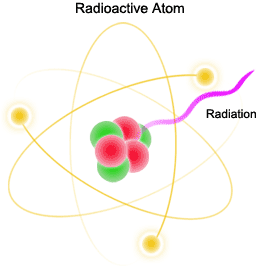
Today’s physics class was all about one of the most fascinating — and slightly terrifying — topics in science: radioactivity. Even though it’s part of the IGCSE syllabus, our lesson went much deeper than just “atoms decay and release radiation.” We explored why radioactivity happens, how it’s detected, and the incredible balance of danger and usefulness that comes with it.
We started by revising the basics — the structure of the atom, with protons and neutrons in the nucleus and electrons orbiting around it. Then came the main event: unstable nuclei. I learned how some nuclei have too much energy or the wrong ratio of protons to neutrons, so they release energy to become more stable. That’s when the three main types of radiation come in — alpha (α), beta (β), and gamma (γ) — each with different strengths, speeds, and penetrating powers.
But this lesson wasn’t just about definitions. We went into the mathematical and experimental side of things too. We studied half-life, which shows how the activity of a radioactive isotope decreases over time — and solving those decay equations really showed how math and physics connect perfectly. We also discussed real-life uses of radioactivity: medical imaging, carbon dating, and industrial detection — plus the precautions scientists take to handle these materials safely.
The best part was understanding how radiation isn’t just some random danger from movies — it’s a powerful natural process that scientists can harness when they understand it properly. From nuclear power to cancer treatment, radioactivity plays a massive role in modern technology and medicine.
In conclusion, today’s lesson was both intense and inspiring. Radioactivity is one of those topics that reminds me how physics reveals the hidden workings of the universe — the things happening inside every atom, all the time, silently shaping the world around us.
 Louis La Minh Hoang
Leave a comment