Today I spent my study session revising trigonometry, and it turned into a solid mix of recalling key identities, applying angle relationships, and solving problems that required careful reasoning rather than quick memorization. Even though I’ve learned these ideas before, revisiting them with more experience made everything connect more smoothly.
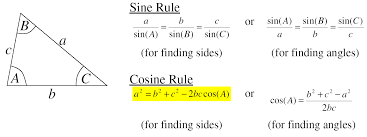
I revised the sine rule and cosine rule, paying attention to when each one is appropriate. Some questions required switching between them depending on which sides or angles were known. The cosine rule was especially important in finding unknown sides in scalene triangles, and it was interesting to see how much geometry depends on that one identity.
I also reviewed trigonometric identities and angle transformations, simplifying expressions, and complementary relationships. These appeared in several past-paper style questions, and solving them correctly depended on remembering the sign changes and quadrant behavior.
The most challenging problems involved combining multiple skills — using an identity, substituting values, forming equations, and sometimes solving for angles that weren’t straightforward. These questions reminded me how precise trigonometry can be: one small mistake in rearranging, and the answer changes completely.
By the end, the revision helped reinforce both the computational side of trigonometry and the deeper logic behind it. Working through these problems made the topic feel more structured and predictable, and I could see clearly how each formula fits into the bigger picture of geometry and algebra.
Today’s trigonometry revision wasn’t just practice — it was a step toward mastering the entire framework.
 Louis La Minh Hoang
Leave a comment