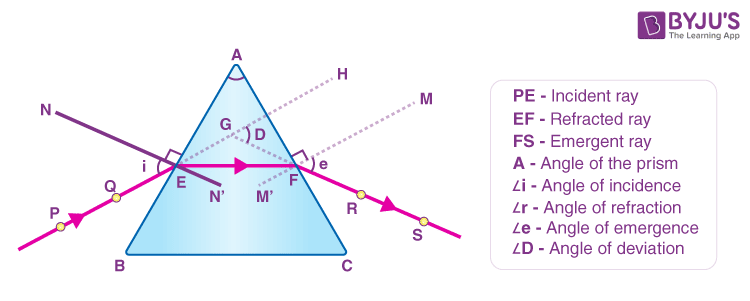
Today’s physics lesson was all about prisms, and even though prisms seem simple at first glance, the deeper we went, the more the geometry began to bite. This wasn’t just “light enters, bends, and comes out”—it was a full exploration of how refraction interacts with the geometry of a transparent solid, and how every angle matters.
We started by reviewing the basic laws of refraction, but very quickly moved into the advanced problem-solving side. Instead of being given neat diagrams, we had to construct everything ourselves: the normal lines, the incident ray, the refracted ray, the emergent ray, and all the exact angle relationships inside the prism. Errors anywhere would break the entire solution. It felt like doing precision engineering on paper.
One of the main focuses today was deviation angle—how much the prism bends the light overall. We learned how to calculate it using the prism’s apex angle and the angles of incidence and emergence. The challenge wasn’t the formula but the geometric reasoning behind it. Each step depended on using triangles formed inside the prism, tracking the exact angle the ray makes with each face.
We also explored conditions for minimum deviation, which required understanding how the path of the ray becomes symmetric inside the prism. That part felt like a puzzle: you adjust the incident angle until the emergent angle mirrors it.
The hardest questions involved realistic scenarios, like prisms used in binoculars, periscopes, and dispersion experiments. Here we had to think not only about geometry but also about refractive index variations, how different wavelengths deviate differently, and why prisms split white light into a spectrum.
Overall, the lesson turned prisms into a perfect blend of math, physics, and precise diagram work. It was challenging, but it made the entire concept far more solid. A prism is no longer just a triangle of glass—it’s a controlled environment where geometry and optical physics interact in the cleanest, most elegant way.
 Louis La Minh Hoang
Leave a comment