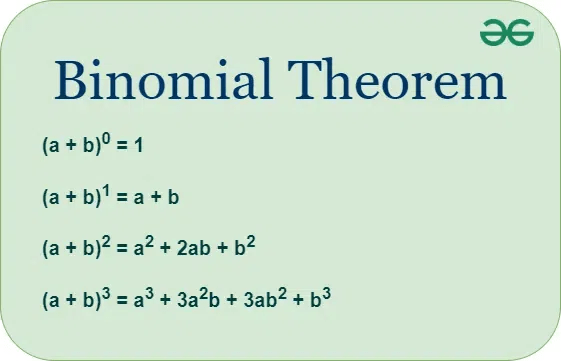
In my recent math lesson, I focused on revising and extending my understanding of the Binomial Theorem, a topic that looks simple at first but becomes much more powerful and challenging when applied to harder problems.
We started by revisiting the basic idea of expanding expressions of the form (a+b)n. Instead of just writing out expansions mechanically, we examined how each term is formed, how coefficients arise, and why the pattern works. Understanding the structure behind the theorem made the expansions feel logical rather than memorized.
The lesson quickly moved into more advanced territory. We worked with large powers, where direct expansion is impossible, and relied on binomial coefficients, combinations, and careful term selection. A major focus was learning how to find a specific term in an expansion without writing out everything, which required precision and strong algebraic reasoning.
We also explored harder applications, such as problems involving variables, fractional coefficients, and conditions placed on certain terms. Some questions combined the binomial theorem with inequalities or required comparing coefficients, which demanded both creativity and accuracy.
By the end of the lesson, I realized that the binomial theorem isn’t just about expansion — it’s a powerful tool for problem-solving. When used correctly, it simplifies complex expressions and opens the door to solving challenging algebraic problems efficiently. This session really strengthened my confidence in handling higher-level binomial questions and seeing the deeper structure behind them.
 Louis La Minh Hoang
Leave a comment