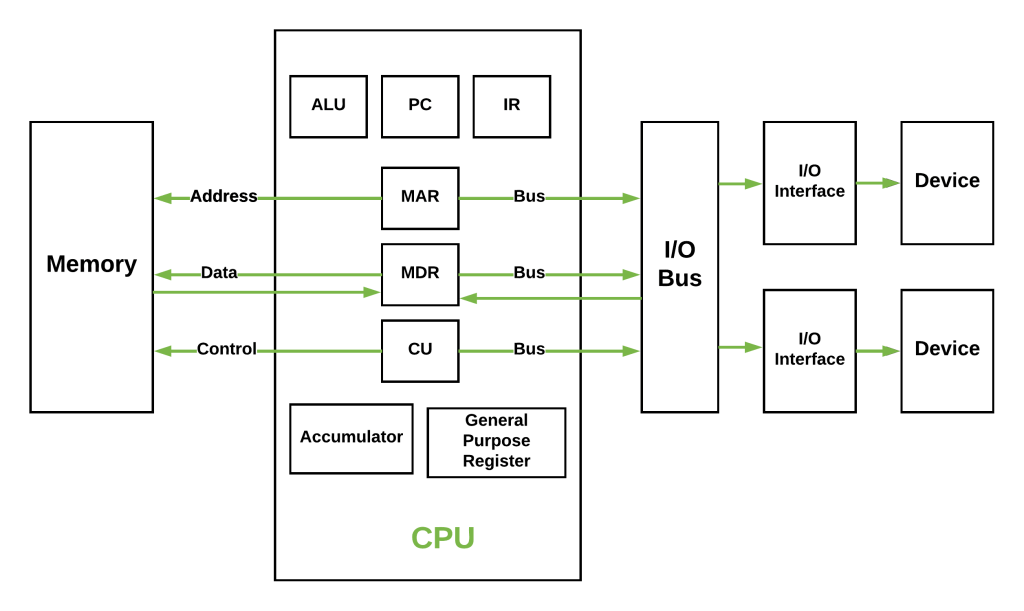
In my computer science lesson, I focused on revising the internal components of a computer, especially the CPU and what actually happens inside it. Instead of just naming parts, this revision helped me understand how each component works together to make a computer function smoothly.
The main focus was the Central Processing Unit (CPU), which is basically the brain of the computer. We broke it down into its key parts. The Control Unit (CU) manages and coordinates all operations, making sure instructions are fetched, decoded, and executed in the correct order. The Arithmetic Logic Unit (ALU) is where all the calculations happen, including arithmetic operations like addition and subtraction, as well as logical comparisons such as AND, OR, and NOT.
We also revised registers, which are small, extremely fast memory locations inside the CPU. These store data and instructions that are currently being used, allowing the processor to work much faster than if it had to constantly access main memory. Understanding how registers interact with the ALU and Control Unit made the whole fetch–decode–execute cycle much clearer.
Beyond the CPU, we reviewed other internal components like RAM, ROM, and the motherboard. RAM temporarily stores programs and data that are currently in use, while ROM holds essential startup instructions. The motherboard acts as the communication hub, connecting all components together and allowing data to flow between them.
This revision wasn’t about memorizing definitions — it was about understanding how data moves inside a computer and how instructions are processed step by step. Seeing how all these internal parts work together gave me a much deeper appreciation of how powerful and efficient modern computers really are.
 Louis La Minh Hoang
Leave a comment