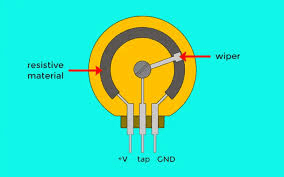
In my physics lesson, I revised the topic of variable resistors, but this wasn’t just about knowing what a rheostat or potentiometer is. The focus was on understanding how changing resistance affects an entire circuit and how to analyze problems logically rather than mechanically.
We reviewed how a variable resistor controls current and voltage in a circuit by changing the effective length of the resistive wire. Instead of memorizing results, we examined how this change influences the distribution of potential difference across components, especially when the variable resistor is connected in series or used as a potential divider.
The problems were more challenging than basic textbook ones. Some questions required predicting how the brightness of bulbs, readings on ammeters and voltmeters, or power dissipation would change as the slider moves. These problems demanded careful reasoning using Ohm’s law, the concept of equivalent resistance, and proportional relationships, rather than simply plugging numbers into formulas.
We also dealt with scenarios involving non-ideal components, such as voltmeters with internal resistance or variable resistors affecting multiple branches in a circuit. In these cases, drawing clear circuit diagrams and identifying which quantities stayed constant and which changed was crucial to reaching the correct conclusion.
By the end of the revision, I felt much more confident about variable resistors. They may seem simple at first, but when used in complex circuits, they become a powerful tool for testing understanding of electricity as a whole. This lesson reinforced how important logical thinking and clear analysis are in physics — even for topics that appear straightforward at first glance.
 Louis La Minh Hoang
Leave a comment