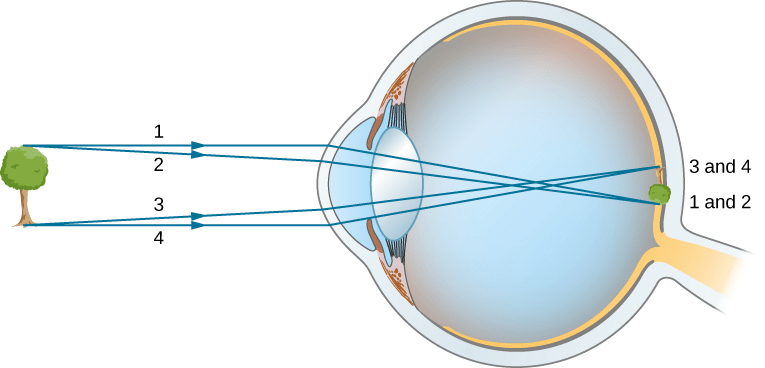
Today’s physics lesson focused on the eye — but not in the biological sense. No anatomy, no retina cells, no rods or cones. Instead, we treated the eye purely as an optical system, a beautifully engineered arrangement of lenses, focal lengths, and image formation. It was all physics, all math, and surprisingly elegant.
We approached the eye as a dynamic lens system whose focal length changes through accommodation. Instead of thinking about muscles and tissues, we analyzed this in the same way we study convex lenses: by considering how changing curvature alters focus, image position, and overall optical power. Treating the eye like a movable, adjustable lens suddenly made a lot of everyday experiences — reading, focusing far away, blurriness — feel like simple lens problems.
One of the biggest parts of the lesson was understanding how the eye forms real, inverted images on the “screen,” which we simplified as the retina. We studied how altering the object distance affects the image distance and why the eye has to adjust its focal length instead of sliding the retina back and forth like a camera. This comparison made the physics behind vision feel almost mechanical — a system of distances, curvatures, and power adjustments.
Then came the vision defects, again through a physics lens. We explored:
- Myopia as the image forming in front of the retina → meaning the lens system’s power is too strong or the eyeball is too long.
- Hyperopia as the image forming behind the retina → meaning the system’s power is too weak or the eyeball is too short.
No biology — just image position and focal length mismatches.
From there, it was all about correction using lenses: concave lenses for myopia, convex lenses for hyperopia, and the physics behind how they shift the image back onto the retina.
We solved problems involving optical power (diopters), which linked directly to lens equations. For instance, determining the required optical power of glasses to correct a specific defect became a matter of combining image distances and focal lengths using the thin lens formula. It was surprisingly satisfying to see how the entire process reduces to straightforward, crisp mathematics when you strip away the anatomy.
Another interesting part was the discussion on near point and far point — not as biological limits but as boundary distances determined by the maximum and minimum optical power the eye can produce. This sparked some challenging problems involving the range of accommodation, minimum focal length adjustments, and determining whether a person can read a book or see a distant sign.
What made this lesson fun was how it turned something familiar — our own eyes — into a playground for lenses, rays, and equations. The focus wasn’t on memorizing facts, but on constructing a physical model that behaves exactly like a lens we’d use in any optical experiment. It was all about image formation, refraction behavior, and the math that determines what we see.
A simple everyday act like looking at something suddenly felt like a series of optical calculations unfolding inside a lens system we all carry around. And studying it purely from the physics perspective made it feel both intuitive and deeply precise.
 Louis La Minh Hoang
Leave a comment