• My physics lesson yesterday was a full revision session on electricity, covering almost everything from the basics to the deeper reasoning behind each concept. Even though it was a revision, the class was packed with details — the kind that really test whether you understand electricity or you only memorized formulas.

    We went through current, voltage, resistance, and all the relationships between them. It wasn’t just the usual “V = IR” and move on. Instead, we focused on why each formula works and what actually happens inside the circuit. Series and parallel circuits became more than just diagrams; we had to break down how charges flow, how energy transfers, and how total resistance behaves in different setups. The teacher kept emphasizing logic, not memorization.

    One of the most important parts was interpreting circuit problems in multiple steps. Instead of solving instantly, we practiced reducing complex circuits into simpler ones, checking current direction, and predicting how changing one component affects the entire system. At this level, even a tiny mistake in reasoning can flip the whole answer.

    We also revisited power, energy, and efficiency. Even if the formulas are simple, the problems often involve multiple ideas at once — converting units, understanding how devices consume power, or analyzing why some appliances waste more energy. The challenge wasn’t the formulas but making sure every step stayed consistent and physically correct.

    By the end of the revision, I felt more confident because the class didn’t just refresh facts; it refined the way I think through electricity questions. It’s the kind of lesson that sharpens both speed and accuracy, making even familiar topics feel much more solid.

  • My physics lesson today went even further into the world of lenses, pushing past the basic ray diagrams and into the full mathematical framework behind how images form. Instead of just drawing the principal rays, we focused on the core formulas, how to apply them correctly, and how to handle tricky problem variations that appear in advanced exams.

    We started with the fundamental lens formula, which connects the object distance uuu, image distance vvv, and focal length. But instead of just plugging in numbers, we broke down when the formula works, how to choose the correct sign conventions, and how to interpret the final image (real/virtual, inverted/upright, enlarged/diminished). Knowing how to apply the signs was honestly the biggest challenge, since a single mistake flips the entire answer.

    From there, we moved into magnification, which is another crucial formula. We practiced questions combining both formulas, especially ones where you don’t know the image distance and must calculate it from the focal length. These usually involve multiple steps, and I had to carefully track each value to avoid errors.

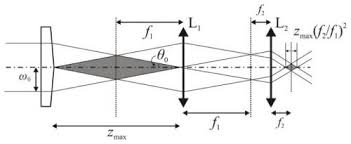
    We also reviewed the properties of converging vs diverging lenses, especially how diverging lenses always produce virtual, upright, and reduced images. But the tricky part was solving mixed-lens systems, where one lens forms an image that becomes the object for the second lens. Drawing those diagrams while applying the formulas correctly was absolutely the hardest part, because one wrong arrow or sign changes everything.

    One interesting part of the lesson was analyzing the limiting cases, like when the object is placed exactly at the focal point. In that case, the image distance becomes infinite, and the rays emerge parallel. Understanding why that happens physically made the formula feel much more intuitive.

    By the end, I realized how much depth lenses actually have once you go beyond the simple drawings. Using formulas like the lens equation and magnification, applying sign conventions, and combining multiple lenses all turn image formation into a genuine mathematical challenge. But now I feel much more confident tackling complex lens problems, especially the ones that require both geometry and algebra to get to the final answer.

  • My geometry lesson today focused on two powerful tools that appear constantly in Olympiad-level problems: Ceva’s Theorem and the Angle Bisector Theorem. Even though both theorems look clean and simple at first, applying them correctly requires a strong understanding of ratios, triangle structures, and how lines interact inside a triangle.

    We started with the Angle Bisector Theorem, which explains how an internal angle bisector splits the opposite side into segments proportional to the adjacent sides. It sounds easy, but using it efficiently means recognizing bisectors hidden inside complicated diagrams. Many problems disguised the bisector behind multiple constructions, forcing me to analyze side lengths, identify equal angles, and express everything in ratio form before finding the missing segment.

    After that, we moved to Ceva’s Theorem, which connects three concurrent lines in a triangle using a multiplicative ratio condition. At first glance it seems abstract, but once we started solving problems, I saw how powerful it is. Instead of guessing intersection points or trying random similarity arguments, Ceva let me confirm immediately whether three cevians could meet at a single point. Working backward from concurrency also helped solve problems where one cevian’s ratio was unknown.

    The hardest part wasn’t the theorems themselves, but the way they were used in combination. Some problems required applying the Angle Bisector Theorem first to find ratios, then plugging those ratios into Ceva’s Theorem to check concurrency. Others needed rearranging Ceva’s formula or converting segments into proportional expressions. Each challenge felt like piecing together a puzzle of ratios and angles.

    By the end of the lesson, both theorems felt far more natural. Instead of relying on guesswork, I could approach geometry problems with precise ratio tools and a more structured way of proving concurrency and segment divisions. These theorems are definitely essential for more advanced geometry, and I’m starting to appreciate how elegant and powerful they can be when used effectively.

  • My physics lesson yesterday was all about revisiting the topic of energy, and even though it wasn’t one of the super-advanced sessions, it was still a really important one. Energy is one of those core ideas that keeps showing up everywhere in physics—mechanics, electricity, heat, waves—so getting the fundamentals perfectly clear actually makes the harder topics much easier later on.

    We went over the different forms of energy again, focusing mainly on kinetic, gravitational potential, elastic potential, and the idea of mechanical energy in general. Even though I already knew the formulas, the real purpose of the revision was learning how to apply them quickly and accurately in different scenarios. For example, we practiced switching between energy states—like how potential energy becomes kinetic energy as something falls, or how work done transforms into internal energy through friction.

    Most of the lesson centred on solving classic energy questions: objects sliding down inclines, balls thrown upward, springs being compressed, and simple system energy transfers. Even though the math wasn’t extremely hard, the revision helped reinforce the idea that energy problems are really about understanding processes, not just plugging formulas into equations.

    We also revisited the principle of conservation of energy and practiced identifying where energy could be “lost” to surroundings through heat or sound. Even in the easy questions, getting used to tracking every form of energy helps build the logical habits needed for more complex physics later on.

    Overall, the revision wasn’t difficult, but it was solid, refreshing, and surprisingly helpful. It felt like tightening the foundation so the advanced lessons that come later will make even more sense.

  • Today’s physics lesson was all about prisms, and even though prisms seem simple at first glance, the deeper we went, the more the geometry began to bite. This wasn’t just “light enters, bends, and comes out”—it was a full exploration of how refraction interacts with the geometry of a transparent solid, and how every angle matters.

    We started by reviewing the basic laws of refraction, but very quickly moved into the advanced problem-solving side. Instead of being given neat diagrams, we had to construct everything ourselves: the normal lines, the incident ray, the refracted ray, the emergent ray, and all the exact angle relationships inside the prism. Errors anywhere would break the entire solution. It felt like doing precision engineering on paper.

    One of the main focuses today was deviation angle—how much the prism bends the light overall. We learned how to calculate it using the prism’s apex angle and the angles of incidence and emergence. The challenge wasn’t the formula but the geometric reasoning behind it. Each step depended on using triangles formed inside the prism, tracking the exact angle the ray makes with each face.

    We also explored conditions for minimum deviation, which required understanding how the path of the ray becomes symmetric inside the prism. That part felt like a puzzle: you adjust the incident angle until the emergent angle mirrors it.

    The hardest questions involved realistic scenarios, like prisms used in binoculars, periscopes, and dispersion experiments. Here we had to think not only about geometry but also about refractive index variations, how different wavelengths deviate differently, and why prisms split white light into a spectrum.

    Overall, the lesson turned prisms into a perfect blend of math, physics, and precise diagram work. It was challenging, but it made the entire concept far more solid. A prism is no longer just a triangle of glass—it’s a controlled environment where geometry and optical physics interact in the cleanest, most elegant way.

  • Today’s physics lesson was all about lenses — not just the theory, but the actual skill of drawing accurate ray diagrams. Even though I’ve learned about lenses before, this session pushed me to be much more precise and systematic with every construction.

    We started by revisiting the two main types of lenses: convex (converging) and concave (diverging). But the real focus was on how to draw the images correctly, using the standard principal rays. Instead of guessing or sketching loosely, we practiced the exact steps: drawing the principal axis, marking focal points, positioning the object, and constructing rays with strict rules. Every line mattered.

    For convex lenses, I practiced the three essential rays: the one parallel to the axis, the one through the focal point, and the one passing through the optical center. It’s crazy how just combining two of them already gives you the exact image point. We worked through all the classic object positions — twice the focal length, between f and 2f, inside f — and each case produced something different: inverted, magnified, reduced, or even virtual.

    For concave lenses, the challenge was understanding how the rays diverge and how the image forms by extending them backward. Drawing virtual images requires more care, because the rays don’t actually meet; you have to extend them cleanly, so the diagram stays accurate.

    What made today advanced wasn’t the formulas — it was the precision. We solved problems where even a small mistake in ray placement could produce a completely wrong image. Some diagrams involved measuring exact distances, matching scales, and explaining the image characteristics based on geometry alone.

    By the end, I felt a lot more confident. Instead of memorizing “the image is inverted” or “the image is magnified,” I could actually prove it through clean constructions. Today wasn’t just learning about lenses — it was learning how to think like someone drawing real optical systems.

  • Today’s chemistry lesson was all about revisiting organic chemistry, and honestly, it felt like tightening every bolt in the entire topic. Even though I’ve studied organic chemistry before, going back through the details helped everything click into place much more clearly.

    We started by reviewing the basics: hydrocarbons, homologous series, and the structure of alkanes, alkenes, and alkynes. But instead of just memorising formulas, the focus was on understanding how each series behaves and why their reactions differ. This made even the simple ideas feel deeper, especially when comparing the stability and bonding of saturated versus unsaturated compounds.

    Once the basics were solid, we moved into reaction pathways—how one organic molecule can be transformed into another. The lesson emphasized not just knowing the products, but truly understanding the conditions, catalysts, and mechanisms behind each conversion. Combustion, cracking, addition reactions of alkenes, polymerisation, and even the tricky oxidation steps all came back into focus.

    We also revised functional groups, from alcohols to carboxylic acids, and how their presence changes a molecule’s properties and reactivity. Recognising these groups quickly became essential for predicting reactions in exam-style questions. Instead of guessing, I had to think logically about how electrons move and what the functional group “wants to do.”

    The hardest part was solving multi-step problems where the question gives several reaction clues and asks you to identify the compounds or draw the reaction pathway. These require everything—knowledge of structures, naming conventions, reaction conditions, and careful reasoning. But working through them again helped build confidence and reminded me how important it is to think systematically.

    By the end of the revision, organic chemistry felt far more connected than before. Instead of scattered facts, it became a linked network of reactions, structures, and rules that actually made sense together. It was a lot of content, but reviewing it thoroughly made everything sharper, cleaner, and much easier to apply.

  • Today’s computer science lesson was all about going deeper into how computers actually handle numbers. Instead of just writing values in decimal, we focused on binary — and more specifically, how computers perform addition, subtraction, and negative number representation using 2’s complement. Even though I’ve used binary before, this lesson finally connected all the pieces together into one complete system.

    We started with binary addition, which at first seems simple, but becomes tricky when carries move several columns at once. The cool part is realizing that computers do this automatically using logic gates, while we simulate the same steps on paper. After getting comfortable with addition, the real highlight came when we started subtracting binary numbers using 2’s complement. Instead of teaching subtraction as a separate method, we learned that a computer never actually subtracts. It adds the negative, and the negative is created through the 2’s complement process: flip the bits, add 1, and suddenly the computer can treat subtraction as pure addition.

    It felt satisfying to see everything click together — especially when checking results with overflow rules and understanding why sometimes numbers “wrap around.” These are the little details that explain how actual computer processors think.

    By the end of the lesson, I could convert numbers, take 2’s complement without hesitation, add and subtract binary values accurately, and explain every step logically. It wasn’t just memorizing steps — it was understanding the system behind digital arithmetic. Overall, this lesson made me feel like I was getting closer to how real computers process information internally, one bit at a time.

  • Today I spent my study session revising trigonometry, and it turned into a solid mix of recalling key identities, applying angle relationships, and solving problems that required careful reasoning rather than quick memorization. Even though I’ve learned these ideas before, revisiting them with more experience made everything connect more smoothly.

    I revised the sine rule and cosine rule, paying attention to when each one is appropriate. Some questions required switching between them depending on which sides or angles were known. The cosine rule was especially important in finding unknown sides in scalene triangles, and it was interesting to see how much geometry depends on that one identity.

    I also reviewed trigonometric identities and angle transformations, simplifying expressions, and complementary relationships. These appeared in several past-paper style questions, and solving them correctly depended on remembering the sign changes and quadrant behavior.

    The most challenging problems involved combining multiple skills — using an identity, substituting values, forming equations, and sometimes solving for angles that weren’t straightforward. These questions reminded me how precise trigonometry can be: one small mistake in rearranging, and the answer changes completely.

    By the end, the revision helped reinforce both the computational side of trigonometry and the deeper logic behind it. Working through these problems made the topic feel more structured and predictable, and I could see clearly how each formula fits into the bigger picture of geometry and algebra.

    Today’s trigonometry revision wasn’t just practice — it was a step toward mastering the entire framework.

  • Today I continued my work on differentiation, building on everything I’ve studied so far while sharpening my understanding through deeper revision. Even though I already know the basic rules, this session pushed me to apply them more fluently and to connect different ideas together in a more advanced way.

    I started by reviewing the fundamental techniques — power rule, product rule, quotient rule, and chain rule — but instead of doing simple textbook examples, I focused on problems that combined several rules at once. This kind of revision forces me to think carefully about the structure of each function, especially when the expression contains nested brackets or multiple layers of composition.

    Then I moved into second derivatives again, this time using them to analyse the shape of graphs. I practised identifying turning points, determining their nature, and explaining why a function is concave up or concave down in specific intervals. It wasn’t just mechanical differentiation; it was about interpreting what the derivatives really meant. Working out where the gradient increases or decreases helped make the graph feel alive and logical.

    I also revised differentiation in the context of real applications — rate of change questions and optimization problems. These problems required more thought than direct calculations. For example, finding maximum values or minimum surface areas meant setting up the function properly, identifying the correct variable to differentiate, and then proving that the critical point was the correct solution. This part of the revision helped me see how differentiation connects directly to real-world ideas.

    Finally, I solved several advanced-style problems involving implicit differentiation and situations where functions were defined in terms of each other. These questions were challenging but satisfying, especially when the final result depended on maintaining careful steps and avoiding small errors.

    Overall, today’s session strengthened both my confidence and my technique. Continuing the study and revision of differentiation helped me see how all the rules and concepts support each other, and how each level of understanding builds toward more complex and elegant mathematics.