• Today’s English lesson with my teacher was once again focused on IELTS Task II writing — something we’ve practiced many times before. Even though we’ve done it several times already, each session helps me understand the structure and techniques more deeply.

    We reviewed the essay format: introduction, body paragraphs, and conclusion. My teacher reminded us that a strong thesis statement sets the direction for the whole essay, and every paragraph should support it clearly. In the body paragraphs, we worked on developing ideas with logical explanations and real examples, while using linking words like moreover, however, and for example to make our writing smoother and more cohesive.

    Since we’ve practiced this multiple times, today’s lesson felt more like polishing our skills rather than learning something completely new. My teacher focused on the finer details — how to maintain a consistent tone, avoid repetition, and write conclusions that leave a strong impression.

    Even though the topic is familiar, I still find every session useful. Each time, I pick up new tips that help me write more confidently and naturally. Step by step, I’m getting closer to mastering IELTS Task II writing!
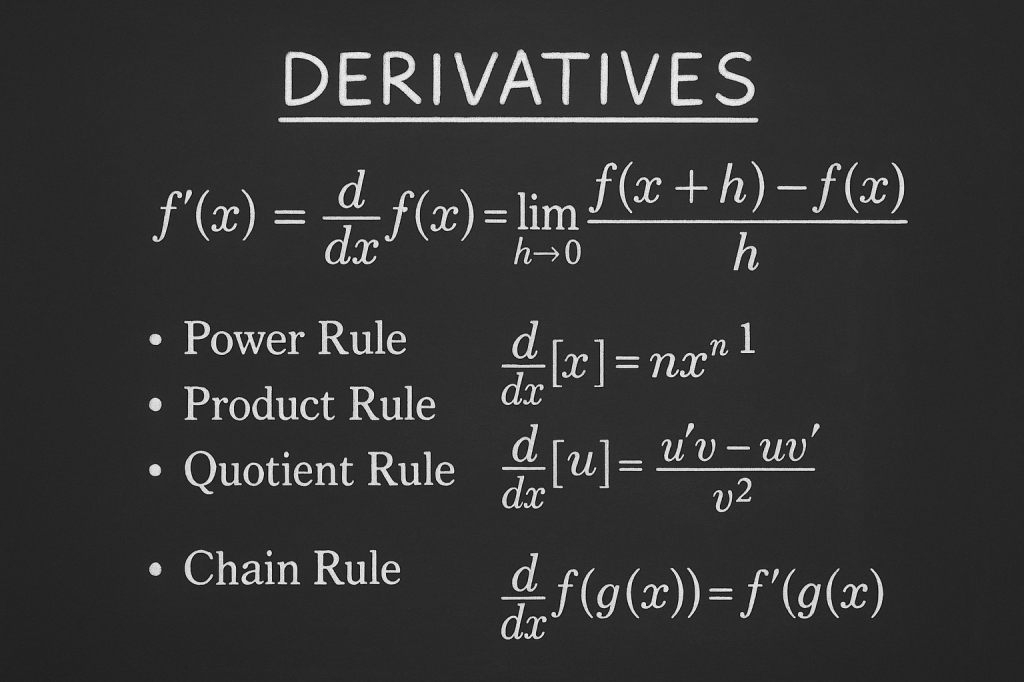
  • In today’s extra math class, we revisited derivatives, something I’d already learned before in another class — but this time, we went more in-depth and connected all the concepts together. At first, we reviewed the basics: understanding a derivative as the instantaneous rate of change or the slope of a tangent line at any point on a curve. It’s like zooming in infinitely close on a graph and seeing how fast it’s rising or falling right there.

    After warming up with simple rules, like the power rule (d/dx[xn]=nxn−1d/dx[x^n] = nx^{n-1}d/dx[xn]=nxn−1) and basic derivatives of constants and linear terms, we got into more detailed rules — the product rule, quotient rule, and chain rule. These rules make it possible to handle complex composite functions, where terms are multiplied or nested inside each other. It was actually satisfying to see how all these separate pieces fit together logically.

    Then we reached the second derivative — which goes a level deeper. While the first derivative tells you the rate of change, the second derivative shows how that rate itself changes. In simpler terms, it’s like checking whether your function is curving upwards or downwards. We talked about concavity, inflection points, and how the second derivative helps determine whether a point on a curve is a maximum, minimum, or a point where the curve changes direction.

    We also did several practice problems, like differentiating polynomials, rational functions, and even a few that needed multiple rules at once. The best part was realizing how derivatives can describe real-world behaviors — like acceleration, optimization, and motion — and how the math we do on paper actually explains how things move and change in reality.

    Overall, even though this wasn’t my first time learning derivatives, this session helped me understand the structure behind them — not just how to do the steps, but why each rule works. And going all the way to the second derivative really made me appreciate how powerful calculus can be once you start connecting everything together.

  • Today’s math tutoring session was all about advanced factorization, and honestly, it was one of the most satisfying topics I’ve done so far. We went way past the basics — no simple “take out common terms” or “split the middle” kind of methods. This time, I learned techniques that felt like real problem-solving tools, not just formulas to memorize.

    My tutor and I worked through expressions that required clever manipulation — rearranging terms, spotting patterns that aren’t obvious at first glance, and using algebraic identities in creative ways. I practiced factoring polynomials that looked completely impossible to factorize at first or tricky cases where the coefficients didn’t seem to fit any pattern. For example: I have to factorize “x^7 + x^2 + 1”.

    What made this lesson even more interesting was realizing how useful advanced factorization actually is in real math problems. It’s not just about simplifying expressions—it shows up everywhere. For example, it helps solve tough quadratic and cubic equations faster, simplify fractions with messy numerators and denominators, and even prove algebraic identities that look impossible at first. I also noticed that many competition-style problems or tricky test questions secretly rely on recognizing a factorization pattern. Once you spot it, the entire problem suddenly collapses into something simple and elegant. It’s like unlocking a hidden shortcut that makes complex math look effortless.

    By the end, I realized that factorization isn’t just a “topic” — it’s a whole skill set for breaking down complicated problems into simpler parts. This session made me appreciate how powerful algebra can be when you truly understand it.

  • Recently, I’ve been studying computer science in an extra class, and to put my learning into action, I was tasked with building a Battleship game in pseudocode. It’s been a fun and challenging project that really pushed me to think logically and creatively.

    At first, I had no idea how to organize such a big idea into code. But through trial and error, with some help from the teacher, I managed to make solid progress. One of the most valuable things I learned was how to use functions in pseudocode. They made everything much more efficient, as I no longer have to repeat codes. I also learned better ways to plan algorithms, manage variables, and structure the overall program better.

    So far, I’ve finished the part that lets players place their ships, and the AI randomly strikes positions on the grid. It’s not a full game yet, but it already feels like a real system taking shape.

    This project has helped me sharpen my problem-solving skills, understand logical flow, and get more confident in writing and improving code.

    In conclusion, my Battleship project has been more than just a coding exercise—it has been a significant step forward in learning how to think like a programmer.

  • Hello! I’m Minh Hoang, an 8th-grade student in secondary school. I’m excited to share all of my posts with friends both in Vietnam and around the world.